Server installation
STANAG On Demand Server runs as a set of microservices. The supplied deployment uses Linux and Docker Compose on a single host.
Production setup
Use a reverse proxy to provide HTTPS and route requests to the application services. Live ingest and WebRTC media may require additional ports, depending on the configuration.
See Production setup, reverse proxy configuration, and the microservices overview.
Local network setup
For evaluation on a local network, see Local network setup.
Installing Docker and Docker Compose
Install Docker Engine and Docker Compose using the Docker documentation. Complete the post-installation steps before deploying the supplied Compose configuration. If you add your account to the Docker group, sign out and sign in again to apply the change.
Follow Manual installation with Docker Compose.
Running on Windows
Run the Linux deployment in an Ubuntu virtual machine. Ubuntu Multipass provides one way to create the VM. Allocate enough CPU, memory, and disk space for recording and playback, and configure access to the VM's service ports.
Offline setup
Download the required container images and deployment files on a computer with internet access, then transfer them to the offline host. See Offline setup.
Advanced setup
Running the server behind a reverse proxy
Set the following value in the deployment environment:
USING_REVERSE_PROXY=true
Configure the proxy to route HTTP, WebSocket, and video requests to the appropriate services. See Reverse proxy configuration.
Serving video
STServer can serve video directly. For production deployments, a dedicated HTTP server can handle video delivery. For example, an Nginx reverse proxy can forward /videos/ requests to a video service on port 8084:
location /videos/ {
    proxy_pass http://localhost:8084/;
    proxy_set_header Host $http_host;
}
The destination host and port must match your deployment. Nginx can also serve the video directory directly.
Video conferencing
Video conferencing uses LiveKit. Deploy a LiveKit server or use a hosted instance, then configure its URL and credentials in the deployment environment:
LK_URL=wss://livekit.example.com
LK_API_KEY=YOUR_LIVEKIT_API_KEY
LK_API_SECRET=YOUR_LIVEKIT_API_SECRET
Use a domain and TLS certificate for a production LiveKit deployment. See Video conference for the user workflow.
License
Without a valid license, STServer runs in a restricted demo mode. Install a .lic file using one of these methods:
- Upload it through the License controls on the Admin page.
- Pass its path with
--licenseFile, or setLICENSE_FILE. - Place it in the server's
licensedirectory.
The current license format does not require a separate license key file.
License options
The license controls live features, multi-sensor support, concurrent users, mission limits, and any expiry date. See License types for details.
Getting a license
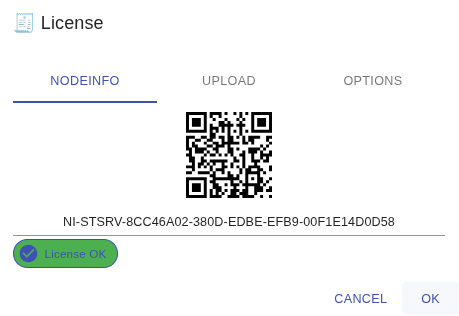
Contact ImpleoTV support and provide the Node Info shown in the License dialog. If you cannot copy the string, send a clear image of its QR code.
Uploading a license
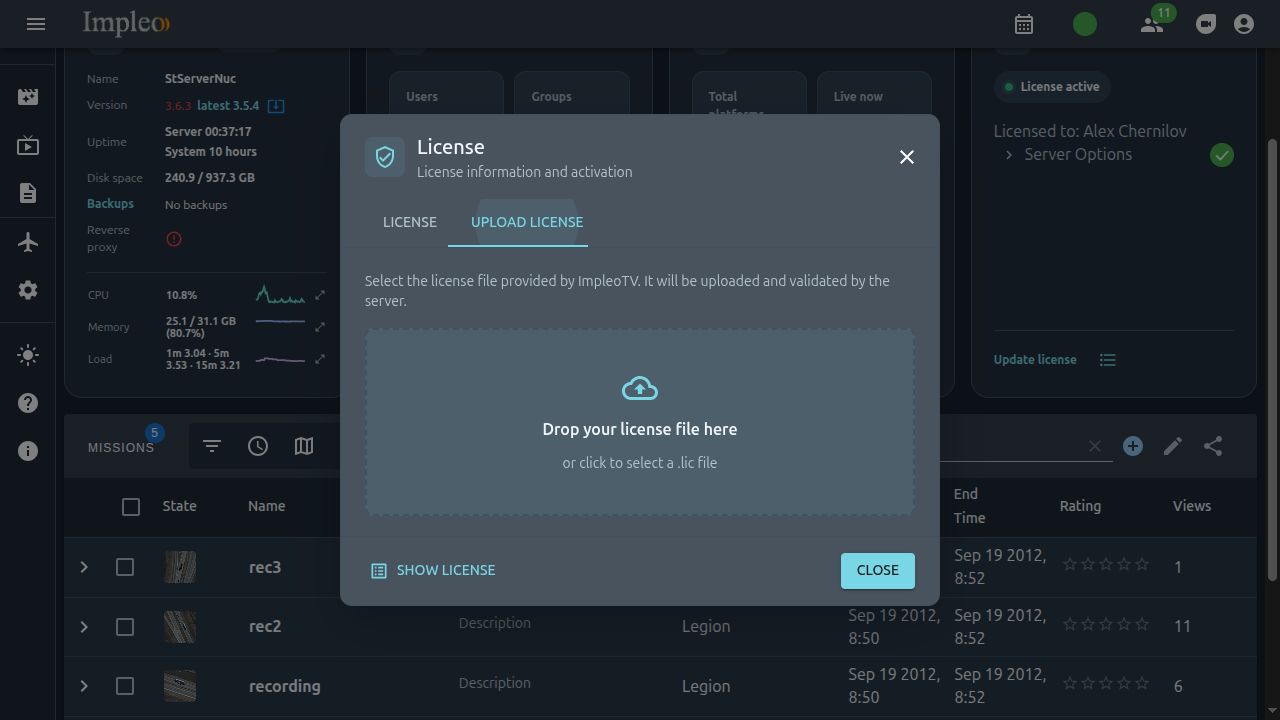
Open Update license on the Admin page, then select or drop the .lic file into the upload area. Review the validation result and enabled features.
License file location
In the supplied Docker deployment, LICENSE_DIR specifies the host directory mounted into the container's license directory:
LICENSE_DIR=${HOME}/licenses/stserver/
Ensure that STServer can read and write this directory. Keep one active .lic file there; automatic discovery uses the first matching file. For a manual installation, the default directory is license under the server's working directory.
Getting help
Contact ImpleoTV support for assistance.